Originally Published at https://www.delawareonline.com/story/news/health/2026/02/02/delaware-education-health-research-international-awarded-1m-grant-seniors-chronic-issues/88472998007/
MILFORD, Del. — Residents of Kent and Sussex counties will have access to tuition-free training for several health care support careers through a $2.3 million workforce development initiative involving Flashpass and Education Health & Research International (EHRI).
The program is designed to prepare residents for administrative and technical positions that support doctors, nurses, and other direct-care professionals, including jobs in medical billing and coding, health information technology, patient access, insurance verification, and medical scheduling.
Training will be offered online, with additional community support available through EHRI and the Milford Wellness Village.
State funding supports workforce development
The funding is tied to Delaware’s Rural Health Transformation Program, a broader state initiative aimed at expanding access to care, lowering costs, and strengthening the health care workforce in Kent and Sussex counties.
Delaware received approximately $157.4 million in federal funding for the program’s first year.
Among the state’s workforce priorities is more than $20.9 million budgeted in the first year to expand training programs for nonphysician health care workers. State officials have said most Rural Health Transformation funding will be distributed through competitive programs and agreements tied to specific projects.
Flashpass and EHRI said their initiative is backed by $2.3 million in funding and will focus specifically on making career training more accessible to residents who might otherwise face financial, transportation or scheduling barriers.
What is upskilling, and how does it work?
Upskilling is the process of helping individuals develop additional skills that qualify them for new responsibilities, more specialized positions or better employment opportunities without necessarily requiring a traditional college degree.
For someone already working in a medical office, that could mean learning medical coding or electronic health records management. For someone working in retail, customer service, or another industry, it could mean gaining the administrative and technical knowledge necessary to pursue a health care support position.
The Flashpass-EHRI program will use flexible online instruction to allow participants to develop those skills while managing existing work and family responsibilities.
The training is especially targeted toward jobs that do not require the years of education associated with becoming a physician or registered nurse but are nevertheless important to keeping medical practices, hospitals and other health organizations operating.
“Through flexible online training and hands-on community support at the Milford Wellness Village, this program equips local residents with practical skills for high-demand healthcare careers,” said Rabbi Y. Halberstam, chief strategy officer at EHRI.
Halberstam said the partnership is intended to connect residents with employment while helping strengthen the health care workforce in central and southern Delaware.
Rural Delaware faces growing health care workforce challenges
The initiative comes as state and federal officials are increasingly focused on shortages throughout the health care workforce, particularly outside major metropolitan areas.
Federal workforce projections estimate the United States could face a shortage of about 141,160 full-time-equivalent physicians by 2038, with nonmetropolitan communities expected to experience significantly greater shortages than metropolitan areas.
Nursing shortages also are projected to hit rural communities disproportionately. The federal National Center for Health Workforce Analysis has projected a 13% shortage of registered nurses in nonmetropolitan areas by 2037, compared with a 6% shortage nationally.
The Flashpass-EHRI program does not train physicians or registered nurses. Instead, organizers say it is designed to address another part of the workforce equation: the administrative and technical employees who handle scheduling, insurance, records, billing and patient access and allow clinical staff to concentrate more of their time on care.
“As we are seeing right across the country, Delaware has a huge demand for clinical support workers,” Flashpass co-founder Will Hinman said.
Hinman said online education could open health care career paths to adults who cannot easily leave work or family responsibilities to attend traditional programs.
“Anybody will be able to become a highly skilled healthcare professional without incurring debt, and they’ll be able to qualify for these roles much quicker thanks to our distance learning tools,” he said.
Milford Wellness Village expands its role as a training hub
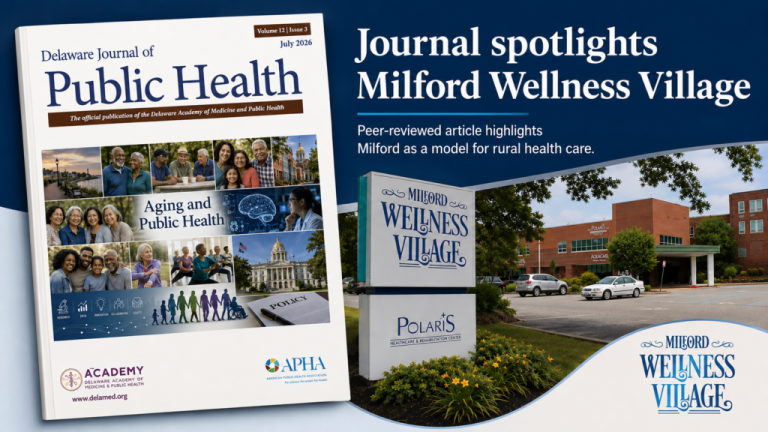
EHRI is based at the Milford Wellness Village, a multipurpose health and education campus that includes medical providers, social-service organizations, workforce programs and educational partners.
The campus already hosts Delaware State University’s Geriatric Workforce Enhancement Program, a separate initiative created through a five-year, $5 million federal grant involving Delaware State University and EHRI. That program focuses on strengthening the workforce serving older adults in Kent and Sussex counties.
The Flashpass partnership expands that workforce development role into additional health care support occupations.
EHRI, founded in 2018, works on health education and community-based programs serving older adults and underserved populations. The nonprofit also participates in chronic-disease education, fall-prevention efforts and other programs through the Milford Wellness Village.
Flashpass is an Ohio-founded workforce development company that works with governments and nonprofit organizations to provide publicly funded training rather than charging students tuition. The company has expanded its model into several states and recently raised $4.1 million in private investment, according to the company.
Measuring success beyond the classroom
For Delaware, the larger question will be how successfully programs such as this translate taxpayer-funded training into workers who remain in Kent and Sussex counties and fill vacancies in the local health care system.
Although the program eliminates tuition costs, its longer-term impact will depend on how many residents enroll, complete training, earn recognized credentials and secure jobs with regional employers.
The announcement did not specify the number of participants expected to receive training, the duration of individual courses or the employment placement goals associated with the $2.3 million investment.
Those measurements could help determine whether the initiative provides a sustainable way to address rural workforce shortages and expand economic opportunities for Delaware residents.
The state’s Rural Health Transformation Program specifically identifies growing Delaware’s health care workforce as one of its central goals, alongside expanding access and preparing the health system for future needs.